PRÉSENTATION
By Joanna Grabski
Foundation Professor of Art History and Dean, College of Integrative Sciences and Arts, Arizona State University, USA
With the Eyes, the Mind, and the Hands: The Mixed Media Work of Artist Viyé Diba
During his career of five decades, artist Viyé Diba (born December 31, 1954 in Karantaba Senegal) has been a most eloquent interpreter of the city where he lives and works. Residing in Dakar, Senegal’s capital city, Diba observes, questions, and illuminates this rapidly urbanizing environment in his mixed media works. After all, as Diba himself tells us, an artist’s primary role is to notice and interpret daily life so others can see what the artist sees and experience its affect. Making use of this vantage point, his work elaborates on the city’s subjects and engages with its materials to bring to our attention the city’s complexities and contradictions as well as its aspirations and possibilities. Diba interprets the city’s structures and aesthetics, teasing out subtlety from an environment of contrasts.
Consideration of his work over the decades allows us to grasp both the evolution of his artistic practice and the evolution of Dakar. Diba has been celebrated widely in exhibitions, publications, and films for his work as an artiste-plasticien, one who works with his hands to fully realize the expressive capacity of materials. While his compositions certainly demonstrate dexterous handling of materials, this orientation is only part of the story. A deeper analysis of his career points out that he is as much an artiste-plasticien as he is an artist-geographer, artist-educator, and artist-public intellectual. These complementary orientations are legible in the questions that have catalyzed his projects over the decades: How do urban residents share space and shape their collective environment? How can the materials of everyday life be recast and reconsidered to exalt their potential for unexpected aesthetic nuance? How might individuals come together to create and evolve urban infrastructure – whether pedagogical, social, or commercial -- that will sustain generations to come?
(…)
-
Viyé Diba is among the artists of his generation whose formal education straddled institutions in Africa and Europe. He studied in Senegal at the Institut National des Arts from 1973 to 1977 and continued his education at the École Normale Supérieure d’Éducation Artistique from 1980 to 1983.[i] In addition to this artistic education, Diba undertook doctoral studies in urban geography from 1985 to 1986 in France at the University of Nice where his research focused on urban public space. His intellectual background in urban geography along with his artistic training have deeply informed his choice of subjects and materials as well as his orientation to art practice. They inform both what he sees and how he interprets what he sees. Engaging the eyes, the mind, and the hands, he reveals to us his perspectives as artiste-plasticien and artist-geographer. This particular combination of visual acumen, conceptual and aesthetic sophistication, and intellectual gravitas results in mixed media works that compel us to look closely at their formal qualities such as colors, volume, and texture while feeling the aesthetics of the city’s environment.
We can trace Diba’s focus on urban subject matter to his figurative acrylic and China ink works from the 1980s. These early depictions offer a glimpse into one of the city’s most paradigmatic public spaces – its bustling markets. By representing the individuals we encounter in the city’s markets such as vendors and women undertaking their daily shopping, Diba prompts our reflection about Dakar’s streets as social and commercial conduits. The artist’s exploration of shared public space, legible early in his career, evolved into elaborate, large-scale installations in subsequent decades. For instance, thirty years later, Diba created installations inspired by streets and markets, such as Tout se Saitdiscussed below, which highlight the role of market vendors in creating highly structured visual environments amidst the disorder of Dakar’s streets.
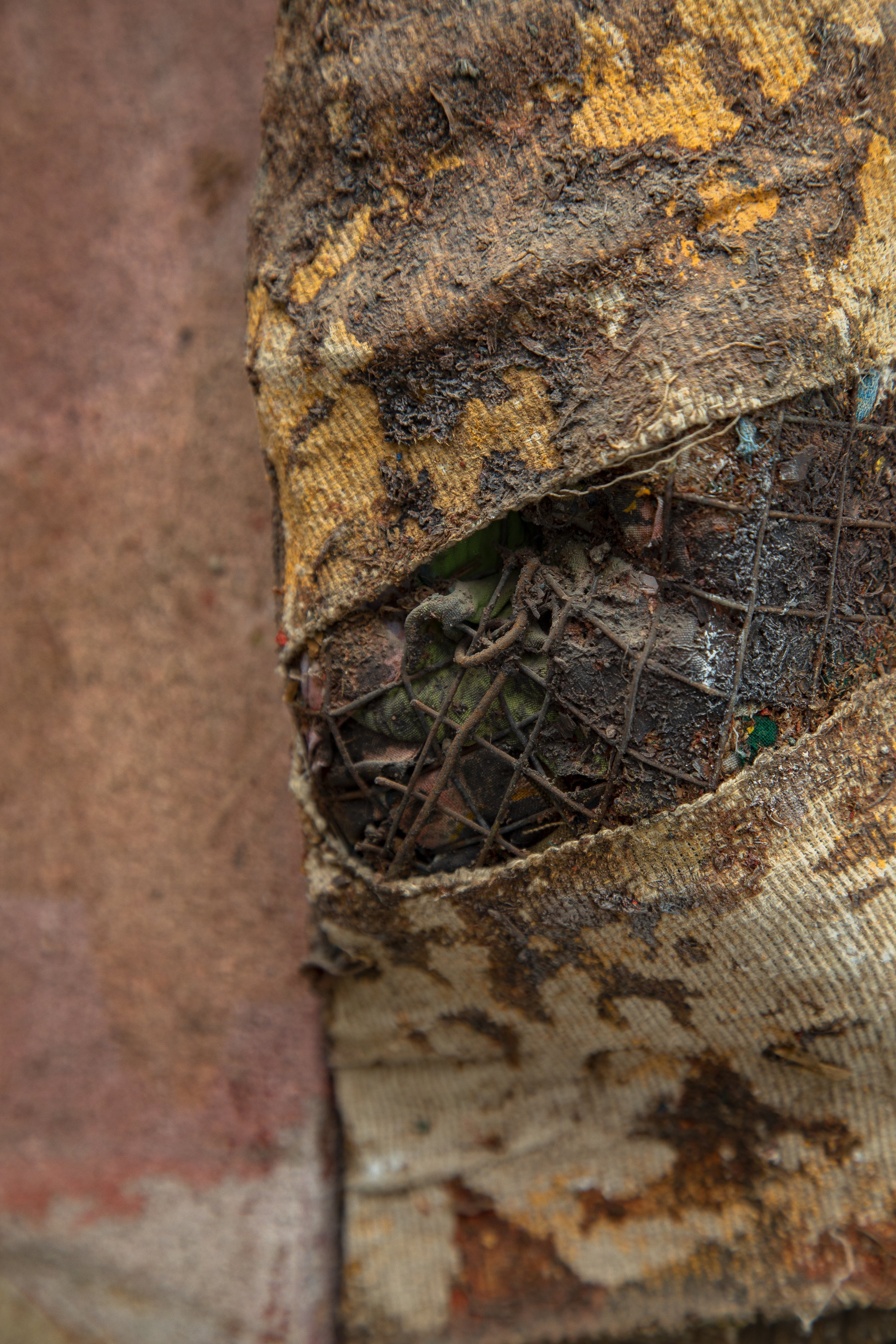
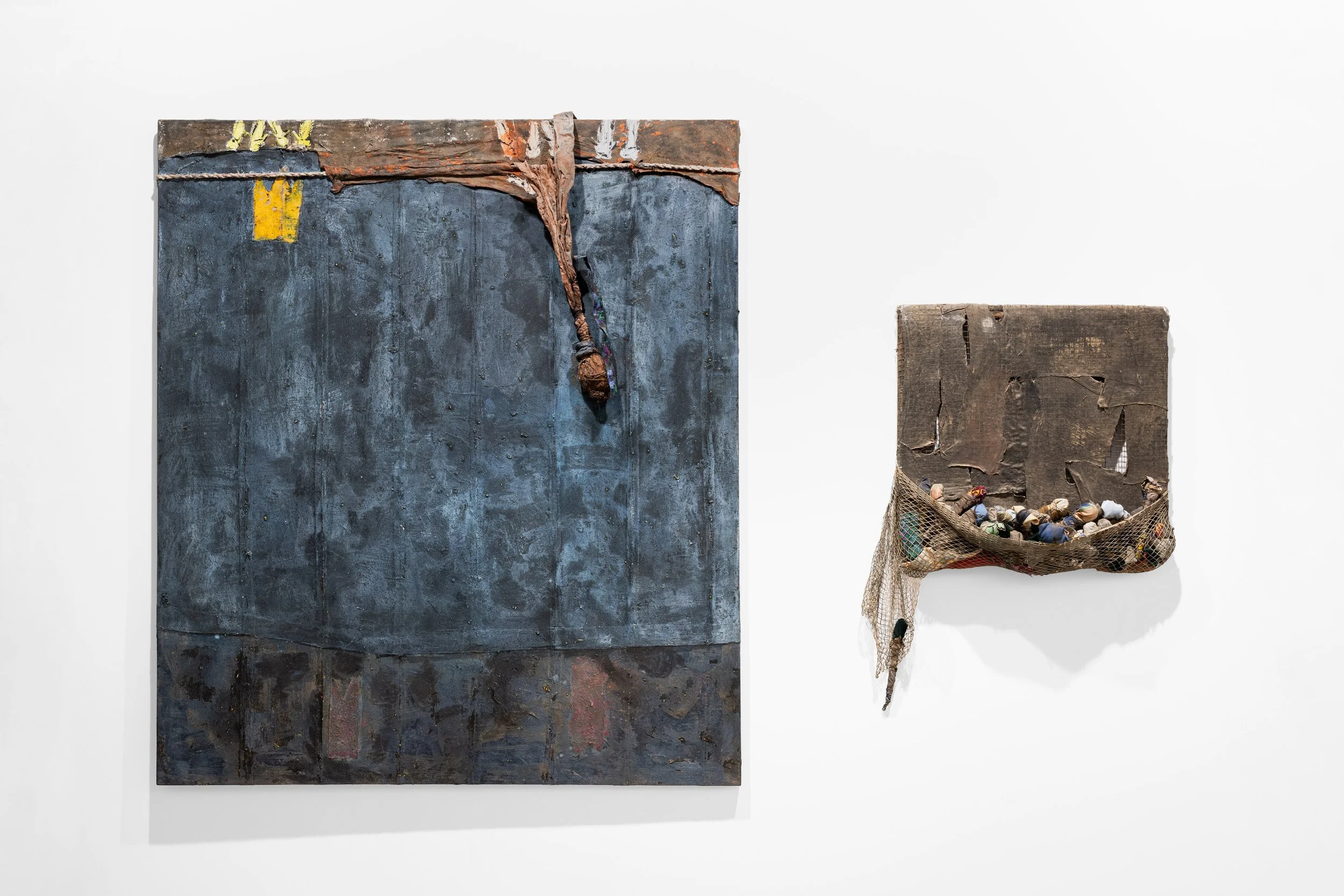
Just as Diba engages with the city’s lines of sight to develop his subject matter, he also looks to the urban environment to acquire the materials for making art. The 1990s was a period when the intersection of street and studio took artistic practice to new levels of impact. Diba moved away from the conventional use of paint, canvas, and frame to make art, choosing instead to explore materials associated with daily life in Dakar. These materials included roughly hewn wooden planks, cotton cloth, and a variety of salvaged objects which he incorporated into increasingly well-structured yet abstract compositions. His approach to art making also became more physically oriented. With his materials on the ground and tools by his side, he created compositions by joining wood and cloth to form his support which he also modified by carving, gouging, wrapping, or adding mixed materials to the support’s surface. The addition of materials to the support allowed him to create alternative foreground and background spaces, further eschewing painterly conventions and developing a distinctive form of mixed media, sculptural canvases.
By the mid 1990s, Diba’s mixed media compositions with heavily modified and augmented surfaces gained interest from the international art world and made a name for him as one of Dakar’s -- and Africa’s -- most esteemed artists. Diba’s artistic work and intellectual voice were critical to charting a path to understanding contemporary African art as having regional and global significance. His works have been included in exhibitions on several continents including several editions of the Dak’Art Biennale where he won the Grand Prix Léopold Sédar Senghor (1998), the Biennale d’Abidjan (1993), the Johannesburg Biennale (1995, 1997), and the Havana Biennale (2000). His work figures into several prestigious institutional collections including the Brooklyn Museum, Centre Pompidou, Harn Museum of Art, Newark Museum, North Carolina Museum of Art, Peabody Essex Museum, UCLA Fowler Museum, and the Smithsonian Institution’s National Museum of African Art.
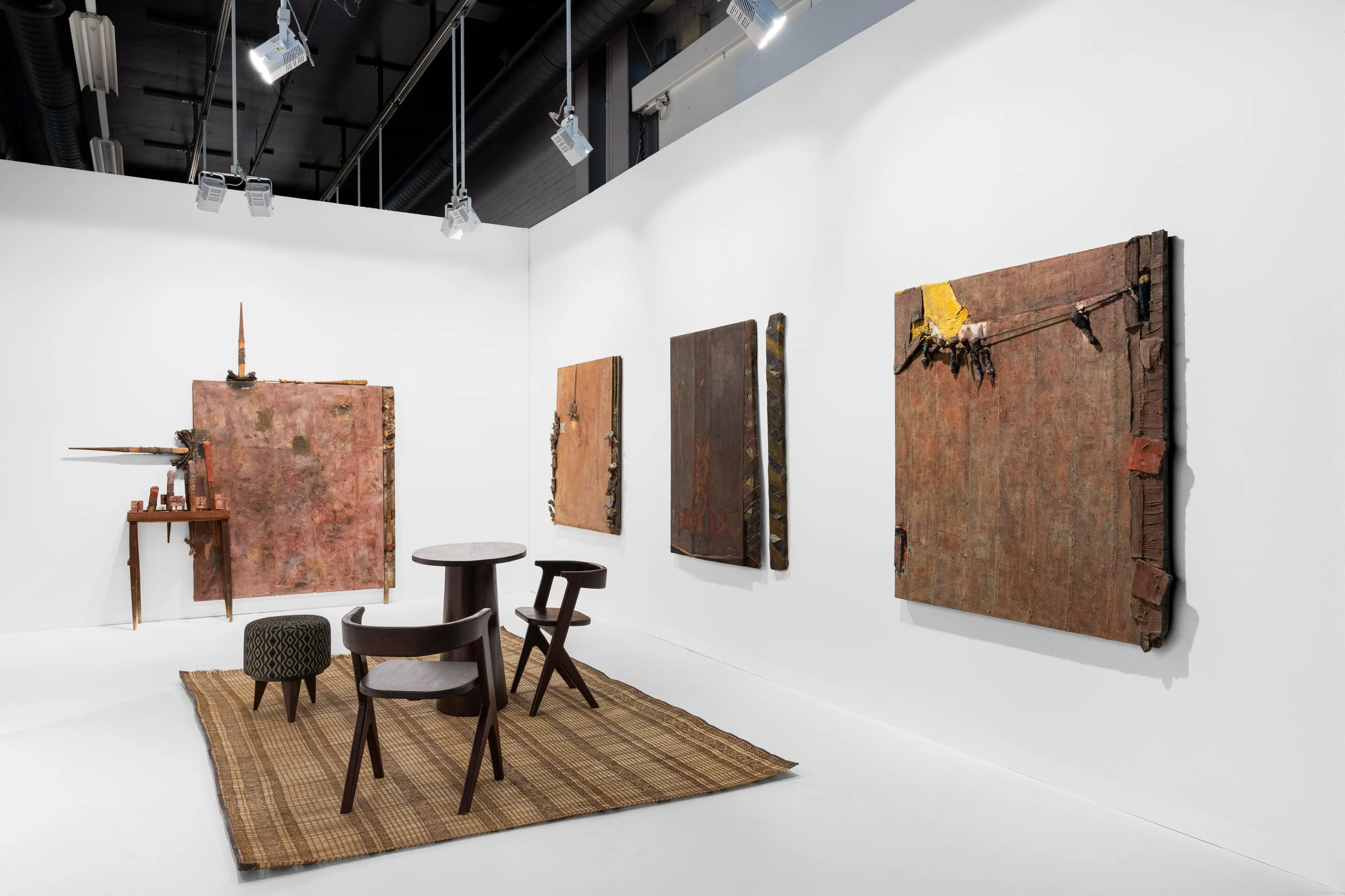
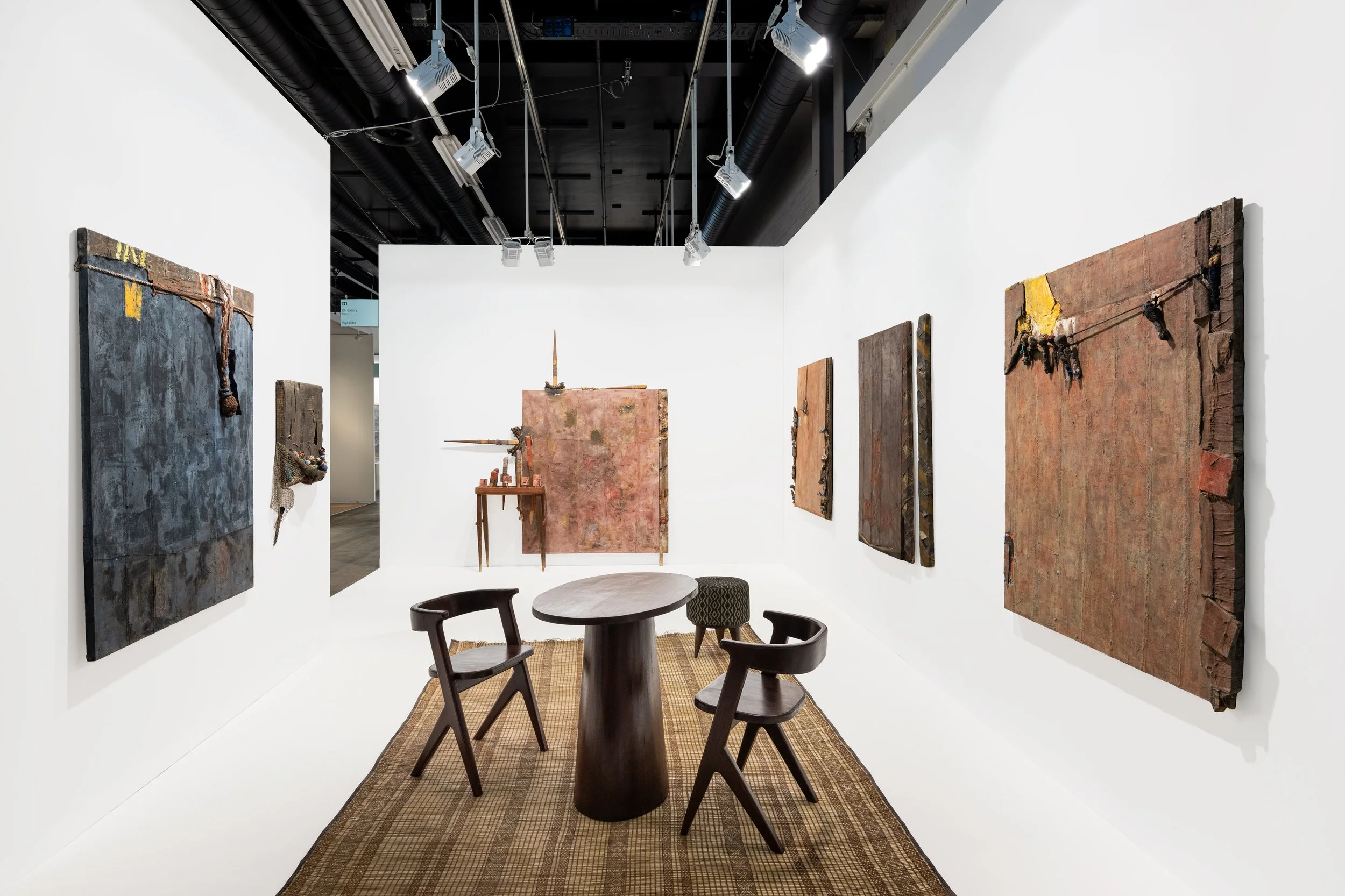
The mixed media works, Kangourou, Le Langage, Piége à Mouche, Choses au Mur II and III, Matière Suspendue, and Composition Jaune, created between 1992 and 2000, are exemplary of Diba’s novel, intertwined perspective as artiste-plasticien and artist-geographer during this period. As these works demonstrate, he “creates with and on” his support, approaching it as both sculpture and painting. His vertically oriented compositions are the result of many physical processes -- building, layering, augmenting, and removing. To advance his exploration of volume, weight, texture, and color, he modifies the wooden planks by carving, incising, and gouging them before wrapping them with lengths of rabbal, hand-woven cotton cloth used for funerary shrouds in Senegal. After covering the wood with cloth, he sometimes tears and sews the cloth to create dimension or volume. Further combining the techniques of sculpture and painting, he attaches bits of cotton rope or pieces of wood while adding color and texture by using a mixture of earth tone acrylic paint, sand, and plant matter.
Diba’s experimentation with materials maximizes their affective capacities and features their aesthetic interplay. The experimentation with materials seen in these works is unprecedented just as it indicates the new conceptualization of being an artiste-plasticien that gained traction in Dakar during the 1990s. The latter role emphasizes the importance of a research-based practice originating in the city streets and playing out through experimentation in the studio. Diba himself describes this orientation as a commitment to understanding materials as having “information” in them about how they can be used.
Many works from this period combine the methods and techniques of accumulative sculpture and assemblage to explore the boundaries of two-dimensional compositional space as exemplified in Le Langage which elongates the compositional space through the addition of wrapped wood or the composition of Piège a Mouche which features a variety of objects suspended in fishing net. The net filled with objects makes a dual reference to the artist’s environment: it evokes the process and tools of Dakar’s coastal fishing community that is so integral to the population’s food supply and city’s economy. At the same time, it makes explicit reference to the massive accumulation of objects associated with Dakar’s urbanization whose population boom was accompanied by the radical visibility of new or used commercial objects in urban public spaces. As the artist has observed, the increased population and increased commercial activity meant that the city’s visual and spatial registers were thickening, becoming denser with people, objects, and for the visually asute – new configurations of both.
The theme of density – its accumulative presence, its order, and its disorder -- has been central to Diba’s practice, originating with concentrations of materials in he aforementioned mixed media canvases and coming to fruition in his large scale installations of the 2000’s. Increased population density resulting from urbanization created challenges for sharing space and strained city infrastructure, as alluded to in his mixed media installation, Nous Sommes Nombreux et Nos Problems Avec (We Are Many and So Are Our Problems), 2008. The conceptual relevance and visual vocabulary of this installation easily crossed geographical sites. It was exhibited in Dakar at the Galerie Arté during the Dak’Art Biennale (2008) and was later reinstalled in 2011 and 2012 at the Tang Museum, Virginia Commonwealth University, and Middlebury College in the USA.
Grappling with the city’s ever-increasing population density, Diba’s installation Tout se Sait (2014) at the Koba Club during Dak’Art 2014, constructs an environment evoking market activity and city streets as dense public spaces transformed by humans into zones for informal economic and social activity. Small tables piled with scraps of colorful cloth populate the ground, reminding us of vendors’ displays in markets and along city streets. The materials of the city give form to this work. The cloth scraps are from neighborhood tailor studios, which are central to the city’s fashion economy. Rolled plastic tubes and mesh sachets remind us of vendors who sell small packets of everyday products like powdered milk and tomato paste allocated from bulk containers. Discarded cloth, wire, plastic, mesh, and wood also reference the littered streetscape in which pedestrians must step over or go around people and discarded items to get to their destinations.
The influence of the city’s forms, aesthetic, and concerns on Diba’s work is profound, nonetheless, it would be remiss not to take note of the flipside – the significance of Diba’s role in influencing Dakar’s art world city. As an artist-educator and artist-public intellectual, Diba has played an important role in shaping Dakar’s art world infrastructure. He was a professor at the École des Arts (1987-2014) where his role as an artist-educator and influential mentor is evidenced by the number of art school alumni whose work was inspired by the urban environment and who use the strategies of a research-based practice in working with materials and concepts. Diba’s use of materials salvaged from the cityscape was central to the emergence of récupération as an expressive form in Dakar’s art world city in the 1990s. During this period, several artists in Dakar came to use materials culled from the urban environment such as discarded metals, washed out driftwood, shattered windshield glass, plastic jugs, well-worn shoes, tattered garments, and reinforcing bar (rebar).
Finally, Diba has been an artist-public intellectual whose commitment to building infrastructure for Dakar’s art world city is epitomized by his service as the President of the Association Nationale des Artistes Plasticiens du Sénégal (1988-2000) and his role as an advisory member of the Dak’Art Biennale for which he also played a founding role. His commitment to advancing knowledge about Dakar’s art and artists is exemplified by his many invitations to residencies and his participation in public conversations. Diba’s disposition to collaboration is part of his legacy which continues to take form in a new space, called Manifa, which he founded in 2022 to host artists’ residencies and exhibitions in Dakar.
Joanna Grabkifor OH GALLERY
NOTES
[i] The latter school which was founded in Dakar in 1979 intended to professionalize art pedagogy by incorporating professors such as Diba who possessed formal credentials and expertise as both artists and pedagogues. Not only was this a historically significant addition to Dakar’s art world infrastructure, it also had implications for the formal training of artists in Dakar.

ŒUVRES
WORKS
Kangourou
1992
Acrylic on canvas, collage on Rabbal and wood
150 x 150 cm
Le langage
1999
Acrylic, wood accessories, wire mesh, rabbal (traditional cotton fabric)
245 x 260 x 38 cm
Piège à mouche
1997
Acrylic, pieces of fabric on wire mesh, wood and textile dolls and fishing net
63 x 100 x 18 cm
Choses au mur II
1997
Acrylic on canvas, rabble, fabric and rope
140 x 150 cm
Choses au mur III
1997
Acrylic on canvas, rabble, fabric and rope
140 x 150 cm
Matière suspendue
1999
Acrylic, rag dolls, wire mesh, wood and rabbal
132 x 140 cm
Composition jaune
2000
Acrylic, rabbal, fabrics, puppets and wood
140 x 150 cm
À PROPOS
ABOUT

VIYÉ DIBA

JOANNA GRABSKI
Joanna Grabski is an art historian who has conducted research on artists, art institutions, urban life, and art world globalization in Dakar, Senegal since 1998. She is the author of dozens of publications on these subjects including the books, Art World City: The Creative Economy of Artists and Urban Life in Dakar (2017) and African Art, Interviews, Narratives: Bodies of Knowledge at Work (2013). In addition to contributing to several edited collections and academic journals, she has curated exhibitions about Dakar-based artists and directed the documentary film, Market Imaginary (2013), focusing on Dakar’s storied Colobane Market as a site for transforming used objects. Grabski is currently the Dean of the College of Integrative Sciences and Arts and Foundation Professor at Arizona State University where she was formerly Director of the School of Art. She earned her doctorate in art history and African sudies from Indiana University.